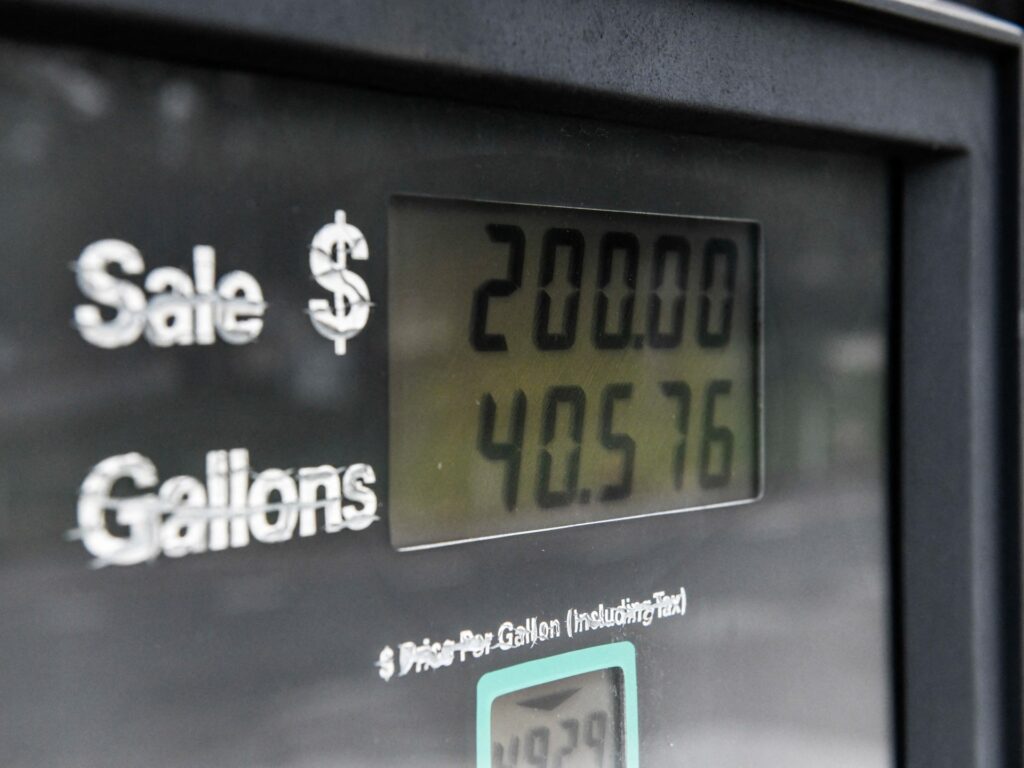
Average US petrol prices hit $4.00 per gallon (3.78 liters), marking the second week of increased costs for consumers.
Petrol and oil prices are on the rise as tensions between the United States and Iran escalate, while Yemen’s Houthis have announced a naval blockade against Saudi Arabia.
Benchmark oil prices have trended upwards in recent days, with Brent crude hitting $91.42 on Sunday, before falling 0.1 percent on Monday to $88.04. US West Texas Intermediate (WTI) reached its highest level since June 12 at $85.39 before retreating 2 cents, or 0.2 percent, to $82.29.
Recommended Stories
list of 4 items
- list 1 of 4Trump threatens Canada with steeper tariff costs over wildfire smoke
- list 2 of 4Trump Media reportedly mulling fee for first access to social media posts
- list 3 of 4Iranians suffer from power blackouts during war and heatwave
- list 4 of 4Yemen’s Houthis declare naval blockade of Saudi Arabia: What to know
end of list
The breakdown of the US-Iran ceasefire drove up prices amid concerns over tanker traffic transiting the strategically important Strait of Hormuz, which, before the war, carried roughly 20 per cent of the world’s oil supply.
Those concerns were compounded by pressure from Iran on their Houthi allies in Yemen to close the Red Sea shipping route, if US attacks on Iranian energy infrastructure continue.
US consumers are also feeling the pressure at the pump. The average price for a gallon (3.78 litres) of petrol topped $4.00, up from $3.87 just a week ago, according to the American Automobile Association (AAA), which tracks daily petrol prices. It marks the second successive week of increases.
The rise comes despite claims that petrol prices are beginning to fall after a report last week showed consumer inflation declined by 0.4 percent on a monthly basis. That was driven by a 9.5 percent drop in petrol prices, according to the Department of Labor’s Bureau of Labor Statistics Consumer Price Index (CPI), released last week.
The inflation data reflects a short-lived reprieve in tensions between the US and Iran before fighting intensified again.
Between July 17 and 19, only 30 vessels travelled through the Strait of Hormuz, according to Kpler data. LSEG data shows traffic was even more limited over the weekend, with only eight ships transiting the waterway on Saturday and four on Sunday.
The tensions are continuing to affect shipping companies. Greece’s Dynacom Tankers said two projectiles struck two of its ships while sailing through the waterway near the Omani coast. The company did not identify who fired the projectiles.
“Higher energy prices remain in focus as a re-escalation in the Middle East tensions adds to concerns that last week’s cooler-than-expected inflationary data may not be enough to deter the Fed from raising interest rates later this year,” David Meger, director of metals trading at High Ridge Futures, told the Reuters news agency.
US markets were mixed amid the escalating geopolitical tensions, but also as the US chip sector rallied after China’s Alibaba previewed its latest artificial intelligence model, following Apple unveiling new AI developments for its Siri assistant.
The tech-heavy Nasdaq was up 0.6 percent, while the S&P 500 gained 0.2 percent in midday trading. The Dow Jones Industrial Average was down 0.25 percent since opening on Monday.
Gold, which is typically considered a safe investment during periods of economic uncertainty, slipped slightly on Monday, despite the heightened tensions. Spot gold was down 0.1 percent to $4,011.96 per ounce in midday trading.
Treasury yields rose 0.5 percent, while the US dollar gained 0.1 percent.