Families across Sudan endure years of displacement, hunger, loss

admin

families-across-sudan-endure-years-of-displacement,-hunger,-loss

More than nine million people remain displaced in Sudan, while nearly 29 million face acute hunger.

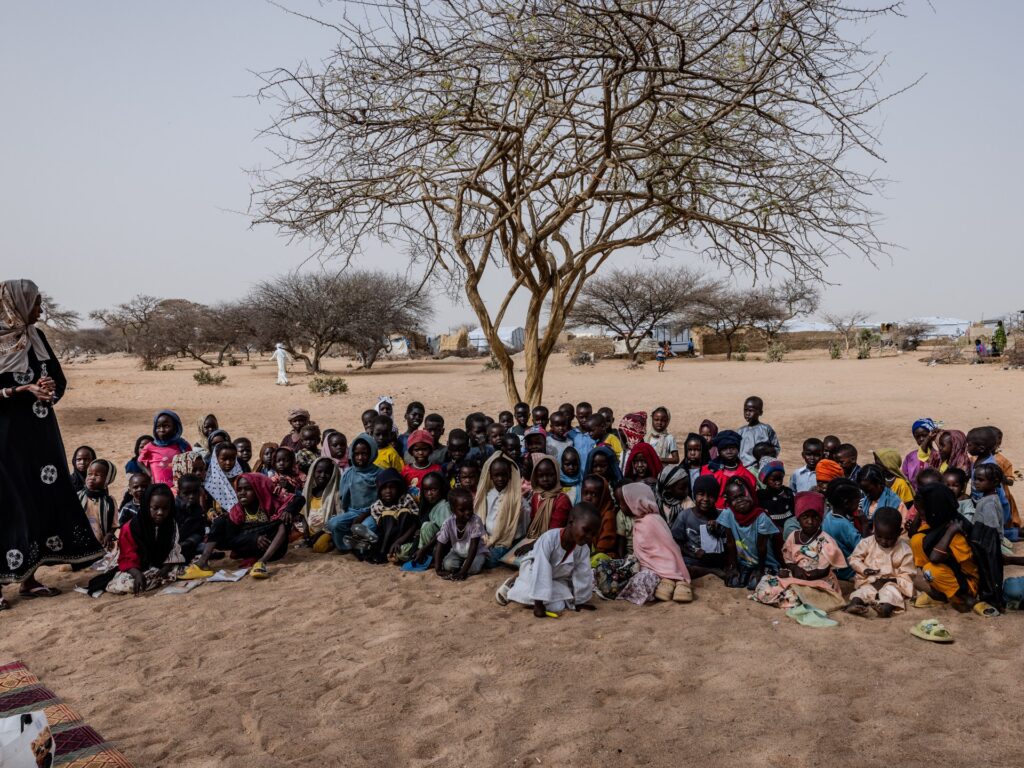
Crowd of children sits under a tree and listens to a teacher.

Sudanese teachers who fled to Goudrane refugee camp have set up a school under the trees, offering children education and a break from often deeply traumatic memories. The schools that do exist in the camp run double shifts but still hold 100 to 200 pupils per classroom. Across Sudan, Chad and South Sudan, only 45 percent of displaced children have regular access to education; in Chad, family separation nearly doubles the risk of child labour. Goudrane refugee camp, eastern Chad [Enayatullah Azad/NRC]

Families across Sudan fled their homes, cities, and country after war reached their streets in April 2023.

Three years later, most are still running.

A recent Norwegian Refugee Council (NRC) survey of 1,293 displaced households across Sudan, Chad, and South Sudan reveals the devastating cycle of loss these families endure. Each forced relocation strips away the remnants of their previous lives.

About 90 percent have lost their homes. Nearly three-quarters have no income. Food shortage has reached critical levels, with more than 80 percent of households in Sudan and nearly all in South Sudan regularly skipping meals.

Inside Sudan, more than nine million people remain displaced, while nearly 29 million face acute hunger.

The cumulative trauma is overwhelming. By their fourth displacement, nearly two-thirds of people report complete exhaustion and depletion of resources. About 65 percent have been separated from family members.

Despite these hardships, remarkable solidarity persists. In Sudan and Chad, about one in three aid recipients continue to share their meagre supplies with neighbours, strangers, and new arrivals with even less.

For three years, this mutual support has served as the invisible backbone of the humanitarian response – yet the survey indicates this lifeline is now stretched to its breaking point.

“In Sudan now, you are always running,” says Amina, who fled Khartoum with four children and the clothes on her back after her husband disappeared in the first days of fighting. “Running from war. Running for food.”

Educational opportunities have collapsed, with only 45 percent of displaced children across the three countries regularly attending school. About 18 percent of households have been forced to send their children to work.

The survey’s conclusion is stark: People have sustained this crisis through resilience and generosity. They are now signalling that they cannot continue shouldering this burden alone much longer.

This photo essay is provided by the Norwegian Refugee Council.

Sudan families endure years of displacement, hunger, and unimaginable loss

Sudanese families embark on arduous journeys across the Sudanese border into eastern Chad, travelling on foot for two weeks or more. They navigate checkpoints and traverse open terrain, with adults carrying children on their backs and bringing minimal possessions. Chad has become the primary host country in the region for Sudanese refugees, sheltering more than 1.3 million people (UNHCR, April 2026). Women and children comprise more than 90 percent of those who have arrived since April 2023. Wadi Fira, eastern Chad. [Enayatullah Azad/NRC]

Sudan families endure years of displacement, hunger, and unimaginable loss

Every day, trucks arrive at the transit centre in Renk, Upper Nile State, the primary entry point for most refugees crossing from Sudan into South Sudan. Since April 2023, more than one million people have sought refuge in South Sudan, fleeing the ongoing conflict in Sudan (UNHCR). The Renk transit centre, originally designed to accommodate just 4,000 individuals, reached a peak occupancy of more than 23,000 people. Renk transit centre, South Sudan. [Richard Ashton/NRC]

Sudan families endure years of displacement, hunger, and unimaginable loss

Amona’s 25-day journey from Khartoum to West Darfur came after a harrowing escape. “We fled our homes with nothing,” she says. “Our houses were locked behind us, full of our belongings. We fled the shelling and gunfire, with bombs falling directly on our homes. One of them hit our neighbour’s house while they were inside, and no one made it out alive.” Now in West Darfur, Sudan, she must walk an hour each way to collect water in small jerrycans that provide just enough for basic cooking and drinking needs. Touloum refugee camp, eastern Chad. [Ahmed Ahmed/NRC]

Sudan families endure years of displacement, hunger, and unimaginable loss

Kuich, 45, originally from Malakal, was forced to flee Sudan with his five children after losing his wife in crossfire. Among the hundreds of thousands crossing into South Sudan, many are returnees – people coming back to a country they had previously fled, often landless and with family members lost or separated during their journey. For many, the transit centre in Renk has transformed from a temporary stop into a permanent home. Renk transit centre, South Sudan. [Richard Ashton/NRC]

Sudan families endure years of displacement, hunger, and unimaginable loss

Zaynab Ibrahim Hamed, formerly an Arabic teacher in Sudan, now resides alone in a modest shelter at Touloum refugee camp. The war killed her father and led to her brothers’ disappearance. Her remaining family members are scattered – some in Chad, some in Sudan, while the whereabouts of others remain unknown. “Life in Sudan was good,” she says. “We had a house, a car, jobs. But then the war came and life became a battle to survive.” In eastern Chad’s Touloum refugee camp, ninety percent of households headed by women have no source of income. Touloum refugee camp, eastern Chad. [Enayatullah Azad/NRC]

Sudan families endure years of displacement, hunger, and unimaginable loss

Muktar Ahmed, forced from his home in el-Fasher, now finds refuge near the Chad-Sudan border, witnessing his children’s education slip away. “My children were going to school in Sudan, but it was destroyed,” he explains. “It is difficult to learn on an empty stomach.” Throughout Sudan, Chad and South Sudan, merely 45 percent of displaced children receive consistent educational opportunities, while almost one in five has been completely cut off from learning. Chad-Sudan border area. [Enayatullah Azad/NRC]

Sudan families endure years of displacement, hunger, and unimaginable loss

Nafisa Taha Mohammed, 45, reached Thobo camp on January 27, 2026, having fled Kadugli on foot two days earlier with her husband and their 12-year-old son. The family was forced to sell their clothing to buy food during their initial days at the camp. “We need everything here and we’re barely getting anything,” she says. Located in Sudan’s Nuba Mountains region of South Kordofan, Thobo camp has become a refuge for families displaced by renewed military conflict in Kadugli that erupted in late 2025. Thobo camp, South Kordofan, Sudan. [Karl Schembri/NRC]

Sudan families endure years of displacement, hunger, and unimaginable loss

Awatif Bahar Mohamed escaped el-Fasher following the murder of her husband and eldest son. On her journey to Chad, armed groups stripped her of all possessions. She reached Goudrane camp with just a single blanket to share among four people. Her surviving son had managed to earn modest income by assisting newcomers with shelter construction, but this work has since disappeared. “We are hungry,” she explains, “but we are patient with the hunger. What is good is that there are no bombardments.” Goudrane camp, eastern Chad. [Enayatullah Azad/NRC]

Sudan families endure years of displacement, hunger, and unimaginable loss

An elderly man departs from the distribution point at Umdulu camp, South Kordofan, carrying his food ration: White beans, sorghum, and salt. Since fighting intensified in late 2025, the camp has primarily received families escaping from Kadugli. Across the region, almost 75 percent of displaced households lack any form of income. Food distributions have become the sole barrier protecting many families from starvation. Umdulu Camp, South Kordofan, Sudan. [Karl Schembri/NRC]

Sudan families endure years of displacement, hunger, and unimaginable loss

Amina fled Khartoum with her four children after her husband vanished during the conflict’s initial days. For two weeks, she journeyed on foot, concealing herself at checkpoints and traveling under cover of darkness until reaching the Nuba Mountains – a region already struggling to accommodate countless displaced families. By observing others, she constructed a shelter and sacrificed her own food portions to feed her children. When a modest cash transfer finally arrived months later, she invested in sorghum seeds for planting and several chickens. South Kordofan, Sudan. [Mathilde Vu/NRC]

Sudan families endure years of displacement, hunger, and unimaginable loss

Local responders, with NRC’s support, provide porridge to children and sorghum with beans to adults at Thobo camp’s reception area. Throughout Sudan and Chad, approximately one in three aid recipients continue to share their limited resources with others – whether neighbours, strangers, or anyone arriving with less (NRC survey, April 2026). For three years, this grassroots solidarity has served as the unseen foundation of humanitarian response. Thobo Camp, South Kordofan, Sudan. [Karl Schembri/NRC]

Sudan families endure years of displacement, hunger, and unimaginable loss

Children gather at a water point in Goz al-Salam camp. The humanitarian crisis in Sudan has reached critical levels, with more than 80 percent of displaced families now skipping meals to survive. Alarmingly, 18 percent of households have been forced to send their children to work. Across the border in Chad, one in four women lacks access to any toilet or latrine facilities, subjecting them to harassment and violence during their extended journeys to find water. The trauma and hardships these children are experiencing will leave lasting impacts that will continue long after this conflict ends. Goz al-Salam camp, Kosti, White Nile State, Sudan. [Ahmed Elsir/NRC]

Sudan families endure years of displacement, hunger, and unimaginable loss

Om Bakheeta Siddiq welcomed displaced families into her home in Um Hani village for three years, providing them with beds, mattresses, food, and water until roads reopened and they could finally return home. “When I see someone struggling, I give without expecting anything in return,” she says. “When these people came to us, they were already like family.” After enduring four displacements, nearly two-thirds of people report being completely exhausted with no resources remaining. Um Hani village, Sudan. [Elias Abu Ata/NRC]

Sudan families endure years of displacement, hunger, and unimaginable loss

Thuraya Hamad al-Nil fled Khartoum to find refuge in Fangooga, where the local community embraced her, providing shelter and crucial support during her most difficult months. She participated in agricultural activities, acquiring new skills she intends to apply upon returning home. The community fostered inclusion by organizing shared iftars during Ramadan. “These moments helped me feel included and reduced the sense of displacement,” she says. Though the local community has been generous, external aid remains minimal in Fangooga, Sudan. [Elias Abu Ata/NRC]

Sudan families endure years of displacement, hunger, and unimaginable loss

In Tawila, North Darfur, displaced residents with barely any resources are preparing meals for those in even more desperate circumstances. Camp committees composed of locals are carefully managing the limited water supplies available. No official infrastructure maintains this system – only individuals who have chosen not to turn a blind eye to others’ suffering. According to NRC’s survey, approximately one-third of aid recipients across Sudan and Chad continue sharing their provisions with others, despite their own dwindling supplies. Tawila, North Darfur, Sudan. [NRC]

Sudan families endure years of displacement, hunger, and unimaginable loss

Abulay Jerema Osman oversees a well situated at a 20-minute walk from Goudrane refugee camp, serving both livestock and displaced persons. “Many refugees are coming from the camp to this well. Here they can take the water freely. We are happy the refugees can get safety here in Chad. They are our guests.” However, he speaks candidly about the constraints: “The international community needs to help Chad support the refugees. The situation for the refugees here is very tough.” Outside Goudrane refugee camp, eastern Chad. [Enayatullah Azad/NRC]

Sudan families endure years of displacement, hunger, and unimaginable loss

A man passes a makeshift stall offering toothbrushes, a tin of juice, and small food packets at Renk transit centre. With virtually no formal employment available, many displaced individuals in Renk must resort to selling whatever items they can to survive. South Sudan has absorbed more than one million people fleeing Sudan’s war (UNHCR), creating an overwhelming burden on a nation already struggling with its own severe humanitarian crisis. Nearly 75 percent of displaced households in the region have no source of income. Renk transit centre, South Sudan. [Richard Ashton/NRC]

Leave a Comment