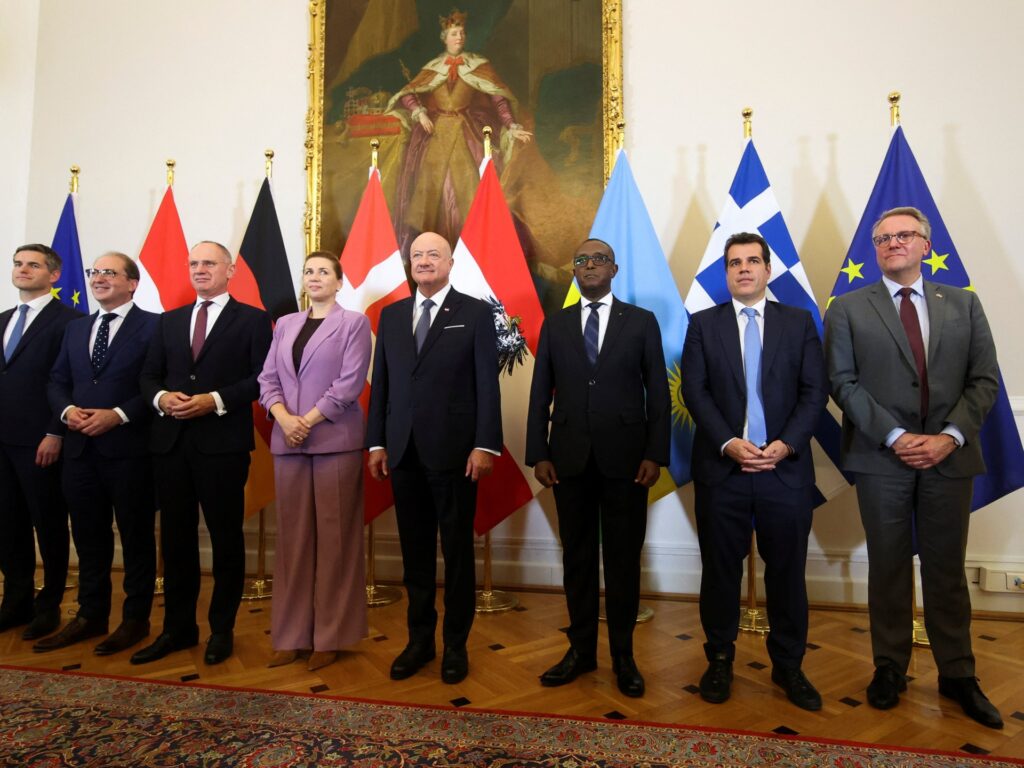
Five European Union countries have announced a deal with Rwanda under which it is set to host rejected asylum seekers.
On Monday, Rwanda joined Austria, Denmark, Germany, Greece and the Netherlands in announcing the scheme in Vienna, with a plan to begin transfers by 2027.
Recommended Stories
list of 3 items
- list 1 of 3EU countries announce migrant deportation centre in Rwanda
- list 2 of 3Five EU countries announce plan to send rejected asylum seekers to Rwanda
- list 3 of 3Who is Jean Leonard Teganya, deported by US over Rwanda genocide claims?
end of list
The governments say the deal would speed up the removal of people with no right to remain in Europe, while rights groups say it could expose vulnerable people to abuse.
Here’s what we know.
What is the scheme?
The five governments want to establish a “return hub” in Rwanda – a facility outside the EU where migrants ordered to leave member states can be transferred, even if they are not from Rwanda.
The proposed scheme would apply only to people in the five countries who are subject to enforceable removal orders, including rejected asylum seekers. The governments would cover the costs, including temporary accommodation.
According to a joint statement, those transferred “will have the opportunity to integrate into the society of Rwanda”. Alternatively, they could voluntarily return to their home country or travel to another country they can legally enter, with assistance from Rwanda and international organisations.
A formal agreement has yet to be signed, and the governments have not specified how many people they intend to transfer. There were 669,365 first-time asylum applications across the EU in 2025, according to figures from the European Commission. On average, 45 percent of these are approved. However, European officials said last year that about 90 percent of rejected applicants remain in the bloc overall.
Why Rwanda?
Dutch Deputy Prime Minister Bart van den Brink said Rwanda was chosen for its “considerable experience” in receiving large groups of migrants and its close cooperation with the UN Refugee Agency (UNHCR) and the International Organization for Migration (IOM).
Rwanda has long hosted large numbers of refugees, most of them from the neighbouring Democratic Republic of the Congo and Burundi.
But over the years, it has also cut deals with several governments to receive deportees. Between 2013 and 2018, Israel deported thousands of Eritrean and Sudanese migrants to Rwanda under a secretive deal.
Rwanda received another 3,000 migrants transferred from Libya in a deal with UNHCR and the African Union in 2019. Last year, Rwanda agreed to accept hundreds of deportees from the United States, with the first seven arriving later that month.
Rwandan Interior Minister Vincent Biruta said the new scheme would offer people with no right to remain in Europe a “second chance”.
A background paper released on Sunday envisions a “cost-efficient and sustainable model”, in which the five EU states would cover the hub’s direct costs and fund integration and migrant welfare projects they say would also benefit Rwandans and aid the country’s development.
The joint statement says the arrangement would form part of an “equal and mutually beneficial partnership” between Rwanda and the five countries, covering not only migration but other areas of common interest.

Didn’t the UK try a similar scheme?
Yes, but that deal, signed in 2022 by the former ruling Conservative government, went a bit further than this. Rather than transferring people after their asylum claims had failed in the United Kingdom, all asylum seekers who arrived in the UK “irregularly” were to be transferred to Rwanda to have their claims assessed there. Those granted asylum would be resettled in Rwanda rather than the UK.
In 2023, the UK Supreme Court ruled the plan unlawful, finding that those transferred would face a real risk of refoulement – being forcibly returned to countries where they could face abuse.
UNHCR, which opposed the plan, told UK courts that Rwanda’s asylum system was inadequate to receive the asylum seekers, among other objections relating to safety and human rights.
The scheme was eventually scrapped in 2024 after the UK’s Labour Party came to power, though by then London had paid Rwanda about 290 million pounds ($390m) under the scheme. Only four people had relocated to Rwanda, all voluntarily.
Under the latest scheme, the five EU states say they would only transfer people who have already been legally processed for asylum and found not to need protection.
German Interior Minister Alexander Dobrindt said this difference made the two plans “incomparable”.
UNHCR, which challenged the aborted UK scheme in courts, is now advising Rwanda and the five EU governments on whether this new plan complies with international human rights law.
What are the humanitarian concerns?
Rights groups have objected to the plan despite Rwanda’s promise of independent monitoring and UNHCR’s involvement, objecting to third-country deportations, in principle, and to Rwanda’s human rights record.
A coalition of 47 groups, including the International Rescue Committee, warned that the deal means people could be torn away from lives built in Europe to countries where they may have no family or networks.
The coalition pointed to the experience of asylum seekers whom Israel deported to Rwanda. “When Israel deported people to Rwanda and Uganda, they were promised status and safety. But research indicates that many were driven on to dangerous onward journeys and into the hands of human trafficking networks,” the coalition said.

Human Rights Watch (HRW) opposed the deal, saying that such third-country transfers were documented to lead to abuses for the deportees, including “arbitrary detention, ill-treatment, destitution” and other serious abuses.
“History has shown that third-country transfers violate rights and cause suffering,” said HRW’s Judith Sunderland.
Amnesty International said similar schemes in the past had proven “unlawful, unworkable and expensive”.
Rights organisations also point to Rwanda’s human rights record as cause for concern. In its report for 2025, Amnesty International wrote of Rwanda: “Forced evictions associated with urban development projects in the capital disproportionately affected low-income and marginalised populations. Labour rights protections were limited, and structural barriers impeded trade union activity. Civic space remained severely restricted and political opposition members faced unfair prosecution.”
HRW said the scheme to send failed asylum seekers would fall short of the EU’s requirement that partner countries respect international human rights law.
The rights group added that four of the five EU countries involved in the deal had raised concerns about Rwanda’s human rights record at the United Nations just this January.